
The Day the Solar Flare Disrupted GPS Farming in the Midlands
A detailed breakdown of how an X-class solar flare paralyzed the Midlands' autonomous agricultural fleet for six hours and what it reveals about our fragile digital infrastructure.

At 05:45 AM on May 4th, 2026, John Miller poured his second coffee of the morning in the control room of Oakhaven Agri, a 4,000-hectare spread in Nottinghamshire. The screens were glowing green, a calm rhythm of data streams indicating that the fleet of twelve autonomous tractors was already three hours into their scheduled planting rotation. The weather window was perfect; low wind, moisture in the soil, and a clear forecast. By noon, Miller calculated, they would have finished the northern quadrant.
At 05:52 AM, the green died.
Every single telemetry terminal flashed red, followed rapidly by a cascade of system-wide warnings. "Signal Lost. RTK Correction Unavailable. Steering Locked."
Miller didn’t panic. He’s been farming for thirty years and managing autonomous fleets for eight. His first instinct was to check the local base station—the fixed point that provides Real-Time Kinematic (RTK) corrections to the tractors, allowing them to steer with centimeter-level precision. The diagnostics showed the base station was broadcasting fine. The problem wasn't local. It was coming from 20,000 kilometers above his head.
An X2.8-class solar flare, the most powerful recorded in the current solar cycle, had just fired a coronal mass ejection directly at Earth. The resulting geomagnetic storm didn't knock out the power grid, but it did something far more surgical: it scrambled the ionosphere enough to degrade the GNSS (Global Navigation Satellite System) signals that modern agriculture breathes.
This is the account of how Oakhaven Agri, and dozens of farms like it across the Midlands, went from total digital automation to a dead halt in seconds. It is also a case study on why our critical infrastructure is far more fragile than we like to admit.
The Silence in the Cabs
The immediate effect was not destruction, but paralysis. These tractors—massive machines costing upwards of £400,000 each—are programmed with a failsafe: if the steering precision drops below 2.5 centimeters, they stop. They do not wander. They do not "guess." They kill the engine and lock the brakes to prevent destroying the crop rows.
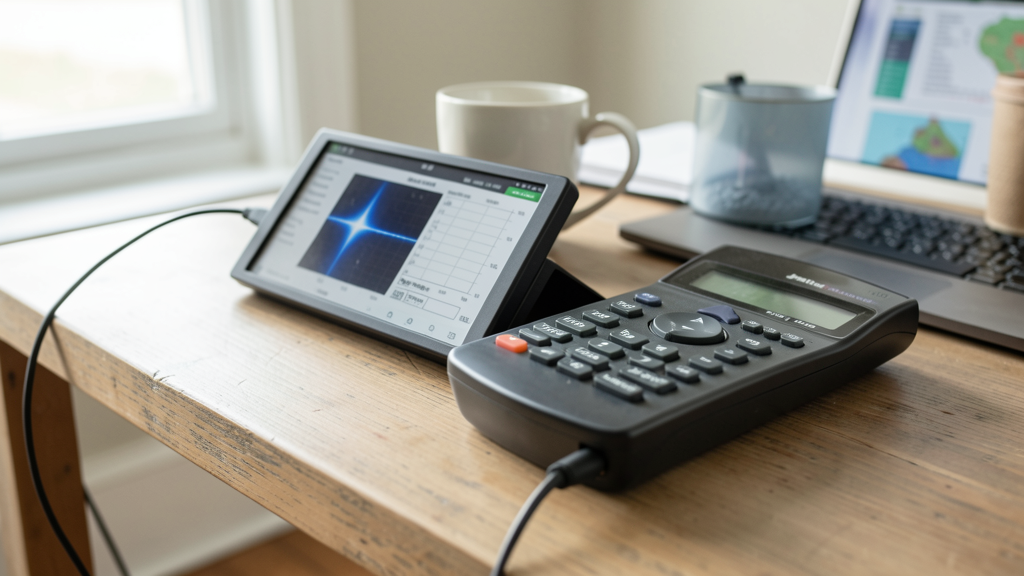
Miller’s fleet was scattered across three fields. Getting to them required manual intervention, which meant driving a pickup truck through the mud, climbing into the cabs, and manually overriding the guidance systems. But even with manual override, the challenge was immense.
Modern tractors rely on GPS-assisted steering for "auto-steer" even when a human is present. Without the satellite lock, the hydraulics fight the driver. The experience is like trying to steer a car when the power steering fails and the alignment is shot simultaneously. Miller and his crew of four spent the next hour physically driving heavy machinery back to the sheds, fighting the resistance of a system that was desperately trying to correct itself based on ghost signals.
The financial bleeding started immediately. It was peak planting season. Every hour these machines sat idle cost Oakhaven approximately £1,200 in lost productivity and contracted labor delays. But the real cost wasn't the money; it was the seed.
They had been planting high-value malting barley. The seed drills had already cut through the soil and deposited the seed in the ground. With the tractors stopping abruptly, the seed in the furrows remained exposed. If the forecast held, no harm done. But if the weather turned—and in the Midlands, it always turns—those exposed seeds would wash away or rot.
Why GPS Is More Than Blue Dots on a Map
We tend to think of GPS as the tool that helps us find the nearest coffee shop. In agriculture, specifically the "precision agriculture" practiced in 2026, it is the backbone of the industry.
The tractors at Oakhaven utilize RTK-GPS. This involves a fixed receiver at the farm (the base station) that knows its exact location. It measures the errors in the satellite signals and sends a correction stream to the moving tractors. This allows the machines to drive in perfect, overlapping lines, ensuring no patch of soil is missed or double-sprayed.
The solar flare didn't burn out the satellites. Instead, it ionized the upper atmosphere, changing the density of the air the radio signals pass through. This variation, known as ionospheric scintillation, changes the speed of the light (the radio signal). Since GPS calculates position by measuring the time it takes for a signal to arrive from the satellite, this speed change introduces massive errors. Positions started drifting by meters, then tens of meters. To a tractor needing to hit a target within two centimeters, this drift made the data useless.
This event exposes a critical vulnerability in the tech-science sector: we have removed the analog redundancy. In 1996, if a satellite went down, a farmer just steered straight. In 2026, the machine literally refuses to move because the software engineers correctly determined that driving with bad data is dangerous.
But safety became a liability. The system saved the machinery but sacrificed the operation.
The Six-Hour Vacuum
From 06:00 AM to 12:15 PM, the Midlands agricultural belt operated in a vacuum.
During this window, Miller contacted his equipment provider. The support line, usually instantaneous, was jammed. He wasn't the only one. Calls were coming in from Lincolnshire, Leicestershire, and Warwickshire. It was a regional blackout of positioning data.
The team improvised. They pulled out an old 2018 model tractor that had a simpler, non-RTK guidance system. It wasn't accurate enough for planting, but it could run a roller over the fields to tamp down the exposed seed. It wasn't ideal—they would lose the perfect depth control—but it was damage limitation.
Watching the old machine chug across the field while the £400k autonomous beasts sat dormant in the shed was a stark image. It highlighted a trade-off we often ignore: efficiency versus resilience. We optimized for maximum yield under perfect conditions, assuming perfect conditions would persist.
This reminds me of the debates around foldable screens vs. durability. We chase the cutting edge, packing more sensitivity and functionality into devices, but often at the cost of robustness against chaotic reality. A solar flare is the ultimate chaotic reality.
By 11:00 AM, the Space Weather Prediction Center downgraded the storm warning. The ionosphere was settling. The satellites, unharmed, began beaming stable data again. The base station re-acquired the lock. But restarting the fleet wasn't instant. Each tractor had to be recalibrated. The "ghost paths"—the routes the computers thought they were on during the drift—had to be purged from the memory.
Did We Just Learn a £150,000 Lesson for Free?
When the final tractor fired back up at 12:45 PM, the relief was palpable. They managed to finish the northern quadrant by sunset, only eight hours behind schedule. The damage was minimal; the weather held.
However, the psychological impact on the management team was significant. Miller convened a meeting the following Tuesday. They didn't talk about seed varieties or fertilizer prices. They talked about space weather.
The realization was clear: They had no protocol for a GNSS outage. Their business continuity plan covered power cuts, internet outages, and cyberattacks. It did not cover the sun.
The "method" they extracted from this crisis is not about buying expensive anti-solar shields. You cannot shield the sky. The method is about architectural redundancy.
Oakhaven is now budgeting for a SBAS (Satellite-Based Augmentation System) subscription that runs on a different frequency band, less susceptible to ionospheric disturbance, as a backup to their RTK. More importantly, they are retrofitting their failsafe protocols. Instead of a full lockout, they are requesting a software patch that allows "dumb mode" steering—releasing the hydraulic lock so a human can take over without fighting the machine, albeit without the automated precision.
This is the engineering equivalent of keeping a spare tire in the boot. We got so used to run-flat tires (automation) that we forgot to carry the jack.
The Fragility of Invisible Infrastructure
The solar flare of May 4th was a nuisance, not a catastrophe. It lasted six hours. It cost the region a few million pounds in delays. It did not trigger a food crisis.
But it was a warning shot. As we integrate battery innovations that could kill lithium-ion and further automate our grid and transport networks, our dependency on precise timing and location data increases. The electrical grid synchronizes distribution via GPS timestamps. Financial markets timestamp trades via GPS. Emergency services locate callers via GPS.
We are building a civilization where the "truth" of our position and time is determined by satellites flying through a hostile radiation environment. The Midlands incident showed us that when that truth is questioned, the system freezes.
The future of tech isn't just about making things smarter or faster. It must be about making them capable of functioning when the data stream turns to noise. Because eventually, the sun will burp again, and next time, it might not be so polite.
The farmers in the Midlands learned to plant with their eyes on the sky again, not just the screens. For the rest of us, we should probably learn to do the same.
Read next
Foldable Screens vs. Durability: Is the Trade-off Worth It?
An engineering breakdown of 2024 foldable longevity statistics compared to traditional slabs to help you decide if the hardware risk is worth the form factor utility.
Beyond Lithium: 3 Battery Prototypes Entering Production in 2026
We analyze three specific chemistries moving from controlled lab environments to factory floors this year, determining which offers a viable alternative to lithium-ion dominance.